Research peptides
SS-31
Available documentary data and items still to verify are detailed below.
Price incl. VAT€115.00
AvailabilityAvailable
SKUSS31
Loading availability…
 0
0
Research peptides
Available documentary data and items still to verify are detailed below.
Loading availability…
02 — Information to verify
SS-31, also known as elamipretide, is a synthetic tetrapeptide of the Szeto–Schiller family. Its sequence alternates cationic and aromatic residues studied in relation to mitochondrial-membrane interactions. Research considers cardiolipin, lipid-bilayer organisation, bioenergetic proteins, and cellular stress responses.
Technical data
Format: 30 mg. Explicit reference sequence: D-Arg–Dmt–Lys–Phe–NH2, where Dmt denotes 2′,6′-dimethyltyrosine. RXKF alone does not represent stereochemistry and amidation.
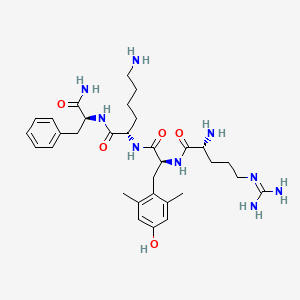
Reference molecular data.
View the PubChem record — PubChem CID 11764719
Dmt denotes 2′,6′-dimethyltyrosine; D-Arg specifies the first residue’s configuration and NH2 the C-terminal amidation. The molecular record excludes any salt or other formulation components.
The sections distinguish biophysical membrane experiments, cell cultures, animal models, and clinical studies with defined formulations. Membrane potential, ATP, reactive oxygen species, and organ function are different endpoints.
The 2020 biophysical paper compares model and mitochondrial membranes using experimental and computational approaches. The peptide partitions into the interfacial region; affinity and binding density depend on surface charge. Cardiolipin contributes to the inner membrane’s anionic environment. The proposed model concerns interfacial physical properties, not simply direct radical neutralisation.
In the same study, binding changes lipid packing without destabilising the bilayer under the tested conditions. Calcium experiments examine divalent-cation distribution at the interface and the energetic burden of mitochondrial stress. Surface-charge changes can affect ions and proteins; they do not imply that every membrane function changes in the same way.
The PNAS study uses chemical cross-linking and mass spectrometry to identify mitochondrial protein interactions with SS-31. Identified proteins mainly concern oxidative phosphorylation and 2-oxoglutarate processes and are associated with cardiolipin. Detected molecular proximity helps formulate mechanisms; it does not itself measure greater energy or performance in an organism.
In the LPS-induced cardiac model, the 2019 study examines IL-6, IL-1β, and TNF-α alongside malondialdehyde, superoxide dismutase, and glutathione peroxidase. Cellular energy and mitochondrial potential are also considered. Oxidative damage, enzyme activity, and inflammatory transcripts describe different response levels; agreement is more informative than one isolated measurement.
Cardiac research includes H9C2 cells and LPS-exposed mice, alongside a pig model of haemorrhagic shock with aortic occlusion. The pig model compares cardiac, renal, inflammatory, and resuscitation indicators; not all outcomes change alike. Systemic-inflammatory injury and injury from interrupted and restored flow are different experimental conditions.
The sepsis-associated-encephalopathy study combines a mouse model with BV-2 microglial cells. It examines mitochondrial Drp1 translocation, fission, NLRP3 inflammasome activity, and recruitment of gasdermin-D’s N-terminal fragment. Mouse cognition and survival are also assessed. Cellular analyses seek links with mitochondrial dynamics without replacing human clinical evaluation.
A 2024 primary paper studies LPS-induced lung injury through histology, transcriptomics, and S100A8/NLRP3/GSDMD pathway analyses. Inflammatory and cell-death endpoints are compared with tissue injury. This clarifies the pulmonary research context without equating LPS exposure, clinical sepsis, and every form of respiratory failure.
The PLOS ONE paper uses Western-diet-fed ApoE−/− mice, not rats. It examines plaque area and composition, oxidative markers, inflammatory mediators, and cholesterol-entry proteins such as CD36 and LOX-1. Plaque changes do not equal lower plasma lipids; compartments and endpoints must remain distinct when interpreting findings.
The aged-mouse cerebral-microvessel abstract considers proteomic changes and mitochondrial components. The muscle review discusses mitochondrial capacity, insulin sensitivity, and muscle function across different targeted antioxidants. ROS also participate in physiological signalling; lowering an oxidative marker does not mean that more antioxidant activity is always better or that lifespan extension is established.
The small 2017 randomised heart-failure trial primarily examines tolerability and short-term echocardiographic changes; it does not alone establish lasting efficacy. The 2022 ARPE-19 retinal-cell paper was retracted: it is identified accordingly in the bibliography and does not support product conclusions. Preprints and conference abstracts are also distinguished from full papers.
Catalog of products presented for research activities. Not for human or veterinary use. This notice does not replace verification of applicable rules.