Research peptides
SEMAX
Available documentary data and items still to verify are detailed below.
Price incl. VAT€58.00
AvailabilityAvailable
SKUsemax
Loading availability…
 0
0
Research peptides
Available documentary data and items still to verify are detailed below.
Loading availability…
02 — Information to verify
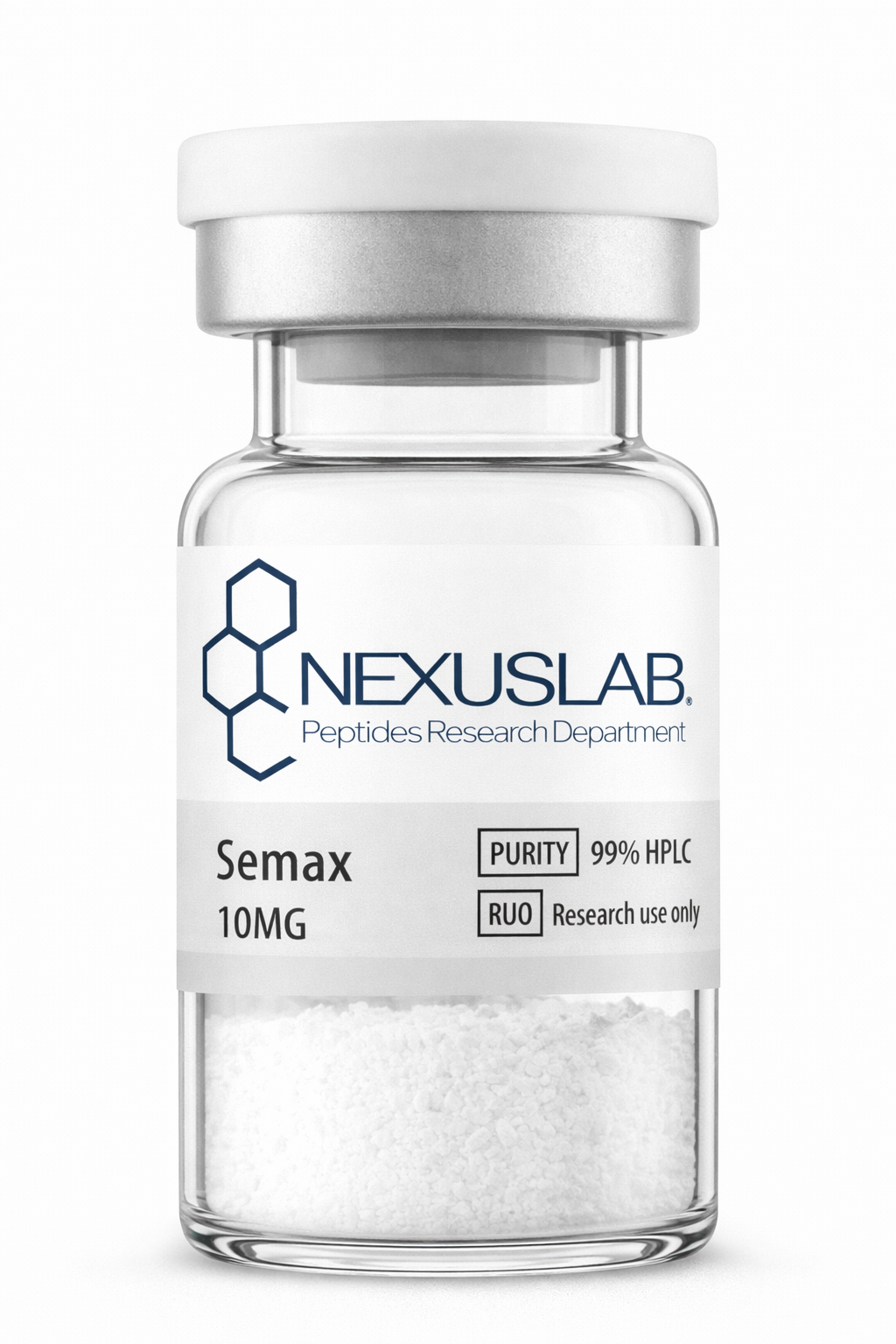
Semax is a synthetic heptapeptide with sequence Met-Glu-His-Phe-Pro-Gly-Pro. Its structure is described as the ACTH(4–7) fragment followed by Pro-Gly-Pro; it is not full-length ACTH.
Technical data
Format: 10 mg. Sequence: MEHFPGP. PubChem CID 9811102 lists formula C37H51N9O10S and mass 813.9 g/mol. The reference describes non-acetylated Semax without assigning modified variants.
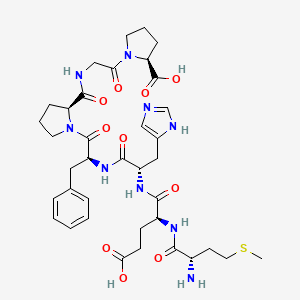
Reference molecular data.
The cited papers analyse immune-response gene expression and protein profiles in rat models of cerebral ischaemia.
Met-Glu-His-Phe corresponds to ACTH(4–7), followed by Pro-Gly-Pro. This construction distinguishes Semax from full ACTH and analogues with acetylation or terminal changes. The nootropic designation describes a research area, not proven cognitive improvement from every material bearing the name.
Rat models compare immune-gene expression, proinflammatory transcripts, and protein profiles after ischaemia and reperfusion. Transcriptomics and proteomics observe different response levels. Agreement between some signals supports mechanistic hypotheses without turning the model into clinical evidence for the product.
10.1007/s00438-017-1297-1 10.1134/S0026893321010040 10.3390/ijms22126179
Research analyses inflammatory mediators and cellular programmes activated after brain injury. Changes in immunoglobulin-related or immune-cell pathways are molecular model readouts. They do not demonstrate general immune enhancement or independently establish which cells generate each signal.
The bibliography includes a conference paper on rat malondialdehyde and protein profiles and a study of audiogenic-seizure susceptibility across mouse strains. Observed effects depend on strain and exposure timing. These models do not establish clinical efficacy in human epilepsy.
The default-mode-network paper uses resting-state functional imaging in a small healthy-volunteer sample. It reports a difference in the rostral network component versus control. A change in connectivity or functional volume is not itself a measurement of memory, attention, or cognitive performance.
Other papers examine acute rat stress and consequences of early-life drug exposure. Neurochemical markers, pain sensitivity, and behaviour are separate outcomes. Findings in one model do not establish treatment of depression or anxiety, and absence of a behavioural effect should not be rewritten as improvement.
Catalog of products presented for research activities. Not for human or veterinary use. This notice does not replace verification of applicable rules.