Research compounds
NAD+
Available documentary data and items still to verify are detailed below.
Price incl. VAT€85.00
AvailabilityAvailable
SKUNAD+
Loading availability…
 0
0
Research compounds
Available documentary data and items still to verify are detailed below.
Loading availability…
02 — Information to verify
NAD+ (nicotinamide adenine dinucleotide) is the oxidized form of a coenzyme found in cells. Together with its reduced form, NADH, it participates in electron transfer across many oxidation–reduction reactions in cellular metabolism. NAD+ also serves as a substrate in enzyme reactions that modify proteins or generate signalling molecules, so its role is not limited to carrying electrons.
The reference listing describes research material for laboratory, analytical, and formulation work. These are experimental contexts, not benefits for a person.
Technical data
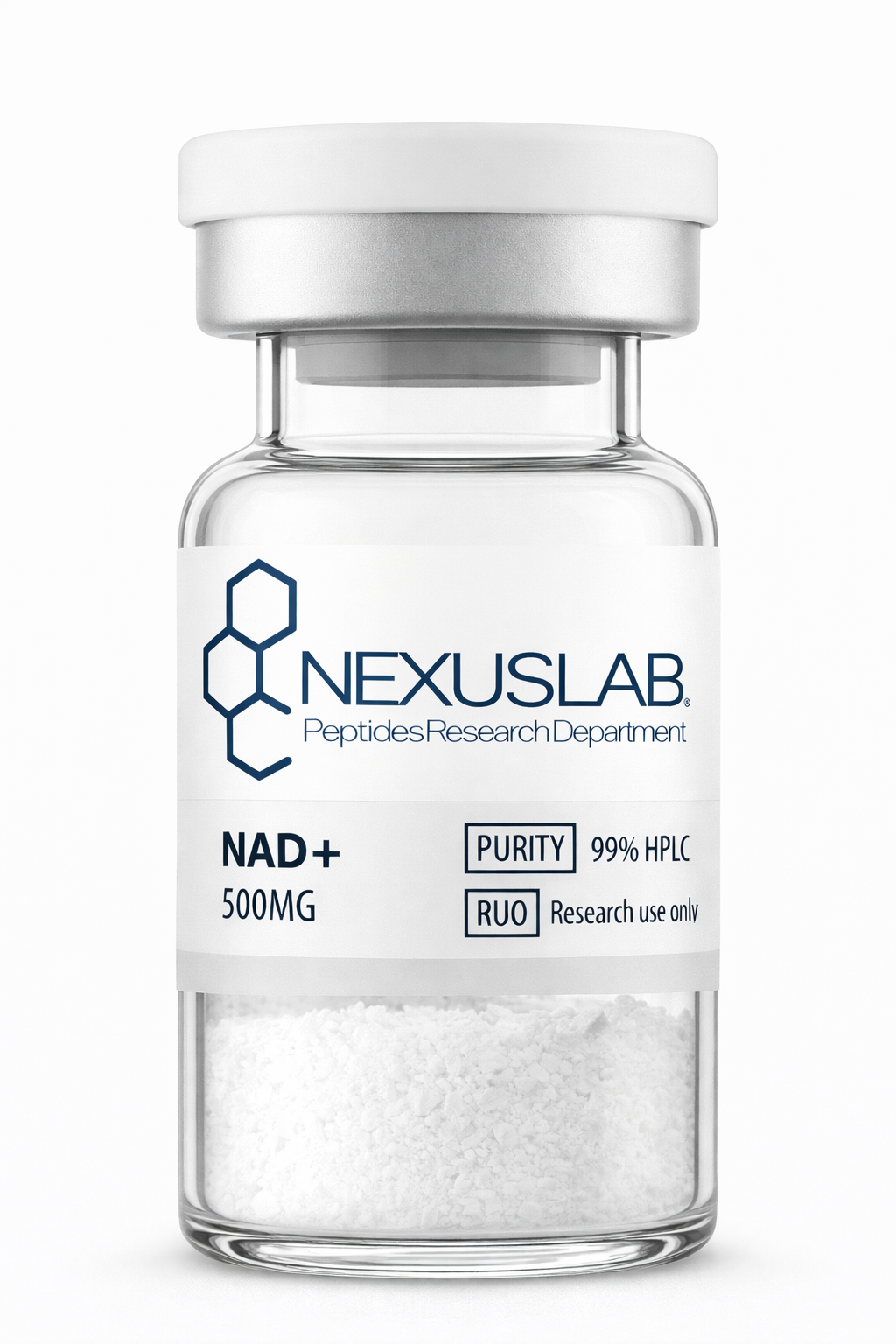
Format: 500 mg. NAD+ is a dinucleotide and has no peptide sequence. Formula and mass refer to molecular record PubChem CID 5892, not a salt or a pack analysis.
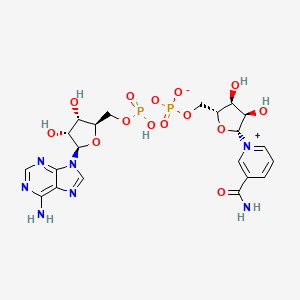
Reference molecular data.
In biochemical research, NAD+ is studied both as a cofactor in electron-transfer reactions and as a substrate consumed by enzyme families such as sirtuins, PARPs, and CD38. Researchers examine how its synthesis, salvage from precursors, and consumption contribute to regulation of intracellular pools. Measured levels can differ between cellular compartments, so a value from one model or tissue cannot automatically be generalized to another.
Research areas include bioenergetics, mitochondrial functions, cell signalling, and changes in NAD+ metabolism observed in different ageing or disease models. The cited papers describe specific mechanisms and experimental systems.
A further area concerns SARM1: the cited structural study examines how NAD+ binding contributes to self-inhibition of this protein. NAD+ metabolism includes synthesis, precursor salvage, and consumption; these processes are examined in distinct compartments and models.
NAD+ accepts reducing equivalents to become NADH; NADH reoxidation makes the coenzyme available again. Glycolysis, the tricarboxylic-acid cycle, and the respiratory chain connect these steps to ATP production. The NAD+/NADH ratio describes a redox state rather than simply total coenzyme abundance.
PARPs use NAD+ in ADP-ribosylation reactions involved in the DNA-damage response. Sirtuins consume it during protein-substrate deacylation. These reactions cleave NAD+ and require pools to be replenished through synthesis and precursor-salvage pathways.
CD38 and CD157 participate in NAD+ metabolism and formation of signalling-related products, including ADP-ribose and cyclic ADP-ribose. Enzyme location and substrate accessibility influence experimental outcomes: NAD+ consumption and calcium mobilisation are different measurements.
NMNAT2 helps maintain axonal NAD, whereas SARM1 has NADase activity. The 2020 structural paper examines NAD+ binding to the SARM1 ARM domain and interactions with the TIR domain. Self-inhibition connects metabolic availability with activation of an axonal-degeneration pathway.
Cardiovascular literature considers energy demand, mitochondrial function, stress responses, and NAD+-consuming enzymes. Nuclear, cytosolic, and mitochondrial pools are regulated differently. A whole-cell measurement does not necessarily reveal where a change occurs or which process causes it.
The Mycobacterium tuberculosis study compares NadE, involved in NAD synthesis, with PpnK, involved in NADP production. Perturbing these enzymes produces different metabolic responses. The work examines bacterial cofactor essentiality; it does not show that commercial NAD+ is an anti-infective treatment.
Studies distinguish NAD+, NADH, and precursors such as nicotinamide, nicotinic acid, NR, and NMN. Yeast experiments measure replicative lifespan and chronological survival, which are different endpoints. Changes in coenzyme levels in organisms or tissues do not establish extension of human lifespan.
Outside cells, ectoenzymes can transform NAD into signalling-related products. Extracellular availability depends on release, degradation, and tissue context. Research also considers adenosine, ADP-ribosylation, and interactions with immune cells; these processes differ from intracellular redox functions.
Catalog of products presented for research activities. Not for human or veterinary use. This notice does not replace verification of applicable rules.