Research peptides
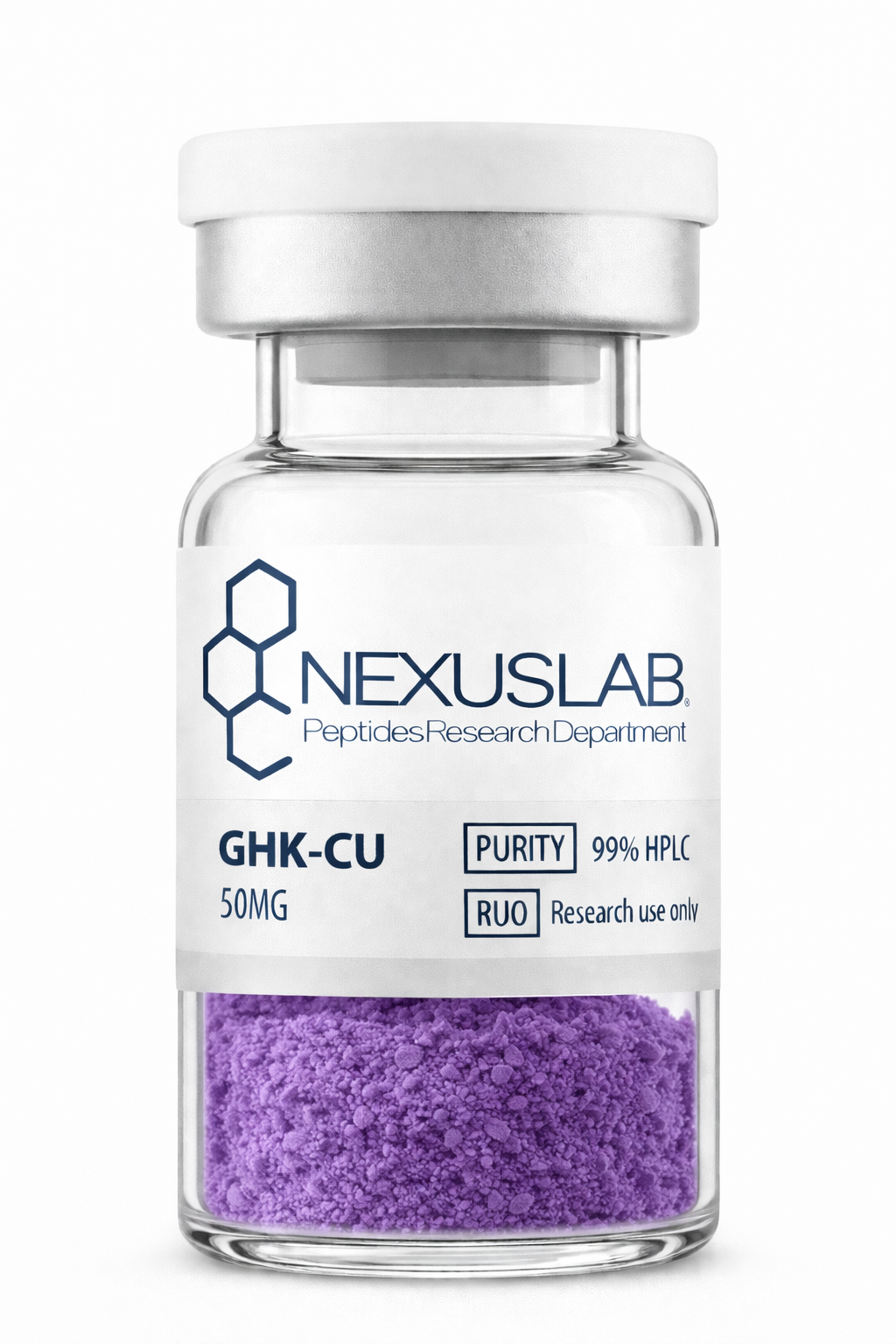
GHK-Cu
Available documentary data and items still to verify are detailed below.
Price incl. VAT€50.00
AvailabilityAvailable
SKUInformation
Loading availability…
 0
0
Research peptides
Available documentary data and items still to verify are detailed below.
Loading availability…
02 — Information to verify
GHK is the tripeptide glycyl-histidyl-lysine. Its histidine residue permits coordination interactions with divalent copper. GHK-Cu denotes species that can differ in stoichiometry, protonation, and structural representation.
Technical data
Variants: 50 mg and 100 mg. The displayed PubChem record CID 9831891 describes copper-bis(GHK), with two GHK ligands per copper ion. Gly-His-Lys denotes one ligand and does not by itself specify the composition of the complex.
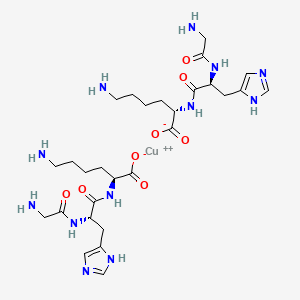
Reference molecular data.
View the PubChem record — PubChem CID 9831891
The sequence Gly-His-Lys identifies the GHK ligand; formula C28H46CuN12O8 corresponds to the copper-bis(GHK) complex.
Studies cover coordination chemistry, formulations, and interactions with the extracellular matrix. The cited 1993 paper measures connective-tissue parameters in an experimental rat model. Results depend on the chemical species and system used and are not evidence of the performance of the item sold.
Glycine, histidine, and lysine form the GHK ligand, whose donor atoms participate in Cu²⁺ binding. pH, copper-to-ligand ratio, and other solution components influence the species present. Records with different stoichiometries are not equivalent descriptions of one standardised substance.
Maquart and colleagues study a rat model allowing tissue formed within an experimental chamber to be collected. Measurements include dry weight, protein, collagen, DNA, and glycosaminoglycans. Increases in some endpoints document that model rather than proving general skin rejuvenation.
Permeation studies distinguish deposition in skin layers from passage across the barrier. Vehicle, complex formation, and tissue integrity influence outcomes. A multi-ingredient topical formulation does not attribute every observation to GHK-Cu alone; penetration and clinical benefit remain different questions.
Delivery systems can combine GHK-Cu with polymer matrices and components possessing other activities. Adhesion, release, mechanics, and microbiological endpoints are assessed separately. In studies combining plant extracts, activity belongs to the tested preparation and is not a measurement of our vial.
The literature includes lipopolysaccharide-induced lung injury in mice and neurological work using GHK without specifying the same copper complex. Some reports are preprints. Free ligand, copper complex, formulation, and model must therefore be identified before comparing results.
The 1998 topical-formulation comparison examines skin samples and ultrastructural changes in a limited participant group. Ingredients and comparisons differ between groups. Sample size, duration, and formulation limit extrapolation to different products or long-term cosmetic outcomes.
Catalog of products presented for research activities. Not for human or veterinary use. This notice does not replace verification of applicable rules.